Rooing (Wool Rise)
Icelandic sheep are one of the world’s most ancient and resilient breeds. They trace their ancestry to sheep brought to Iceland by Norse settlers during the Viking Age, beginning in the late 9th century. Shaped not by intensive human selection, but by centuries of survival in a harsh and unforgiving environment, these sheep retained traits that allowed them to thrive with minimal human intervention. This natural selection preserved traits that allowed them to thrive in the wild — including their ability to naturally shed or loosen their wool each spring, a process known as rooing or wool rise.
What Is Rooing?
Rooing refers to the natural loosening of the fleece as a sheep transitions from winter to spring. Rather than the wool being tightly attached to the skin year‑round, the fleece begins to release at the base, allowing it to be gently pulled away when the timing is right.
This is not a flaw or inconvenience — it is a heritage survival trait. Long before mechanical shearing, sheep needed a way to regulate their coats without human help. Rooing allowed them to shed excess insulation as temperatures warmed, preventing overheating while conserving energy.
Unlike many modern commercial breeds that have been selectively bred to hold their fleece indefinitely, Icelandic sheep retain this primitive shedding instinct. Their genetics remain remarkably close to their original ancestors, giving them the ability to respond to seasonal changes.
Icelandic sheep grow a dual‑coated fleece:
- Tog — the long, strong outer coat that repels moisture and protects against wind and snow
- Thel — the fine, insulating undercoat that traps warmth
As spring approaches, hormonal and environmental cues signal the body to release the fleece. This natural break — the wool rise — allows the coat to separate cleanly from the sheep.

Rooing vs. Shearing
Both rooing and shearing can be humane and appropriate when done correctly, but they are fundamentally different.
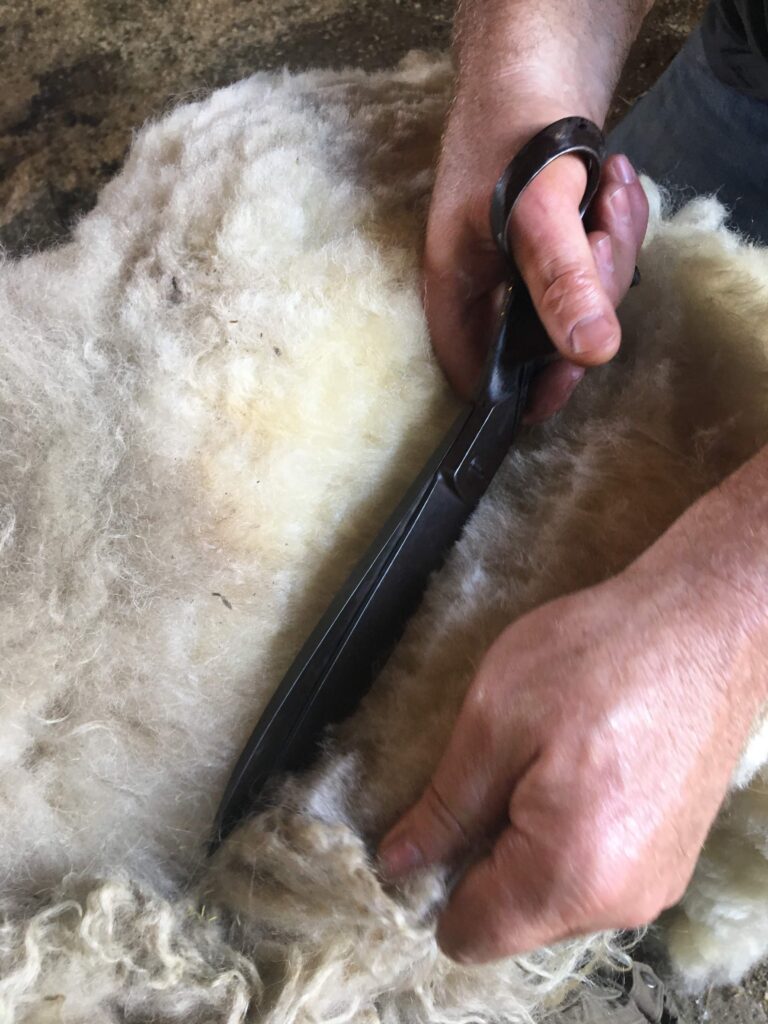
Rooing works with the sheep’s natural cycle. When the fleece is ready, it lifts easily and can be gently removed by hand or with minimal cutting.
Shearing, on the other hand, involves cutting the wool regardless of whether the sheep is naturally ready to release it — a necessity for breeds that do not shed.
For Icelandic sheep, rooing or shearing at wool rise is often:
- Lower stress for the animal
- Faster and easier for the shepherd
- Better for preserving fleece quality
On our farm, we have hand‑sheared our sheep during wool rise with great ease. When the fleece has entered its natural release stage, it comes away smoothly and cleanly, often in a single, beautiful piece.
Working with the wool rise means:
- Very little resistance when removing the fleece
- Minimal discomfort for the sheep
- A calm, unhurried process
This timing honors the sheep’s natural rhythm and allows us to harvest the fleece at its very best.
Fleece removed during wool rise offers exceptional versatility for fiber artists.
Because the fibers are not cut:
- Staples remain long and intact
- There are fewer second cuts
- The fleece holds together beautifully
This makes rooed or wool‑rise fleece ideal for:
- Felting rugs and wall hangings using whole fleece sections
- Carding into lofty batts
- Spinning into roving or yarn with excellent draft and strength
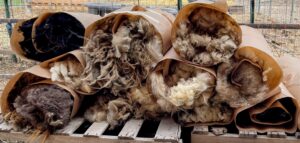
The result is fiber that reflects both quality and tradition.
I will never forget our first spring with Icelandic sheep.
We were doing routine health checks on the flock, and as I reached to catch one of our ewes, I missed my hold — and instead came away with a large handful of wool. My heart dropped. Having raised blackface sheep for years, I was horrified that I had somehow pulled her fleece out.
Within moments, my friend and mentor in Icelandic sheep gently laughed and explained what had just happened. That ewe was not injured. She was entering wool rise.
Until that moment, I had never witnessed rooing firsthand. I was amazed — and honestly a little humbled — by this deep, instinctive design woven into the breed. These sheep were not losing their wool accidentally. They were releasing it intentionally, in rhythm with the season.
At the beginning of wool rise, Icelandics can look rather scruffy. Large clumps of fleece begin loosening, often first around the neck and shoulders. To the untrained eye, it can look concerning. But now, it is one of my favorite sights of spring. Those scruffy patches are a quiet signal that once again, these sheep are perfectly in tune with nature and their survival instincts.
Knowing When a Sheep Is Ready to Roo
Timing is everything. Not every Icelandic sheep will roo at the same rate, and some individuals may still require shearing.
Signs a sheep is entering wool rise include:
- The fleece lifting along the neck, spine and sides
- Wool that separates easily when gently pulled
- Seasonal timing, typically spring to early summer
If the fleece resists removal, it simply isn’t ready yet. Patience is key — forcing the process defeats its purpose.
Rooing connects us to generations of shepherds who worked in partnership with their animals, not against them. It reflects the remarkable way Icelandic sheep have been hard‑wired to thrive, carrying survival wisdom in their very fiber.
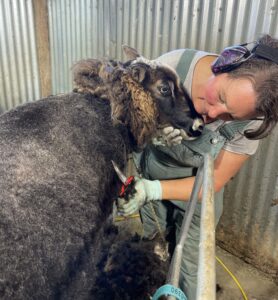
By honoring wool rise, we preserve not only fleece quality, but also the integrity of this ancient breed and the slower, more intentional rhythm of heritage shepherding.